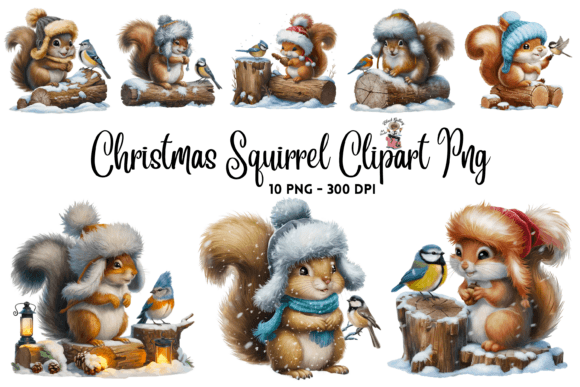
Reviewing the Christmas Squirrel Clipart PNG Bundle
As a designer who spends more time staring at stitch simulations than I do sleeping, I have learned to be skeptical of cute. Cute is easy. Cute is often messy when translated from a flat screen to textured fabric. When I first opened the Christmas Squirrel Clipart PNG Bundle, my initial reaction was not just about the aesthetic appeal, but about its structural integrity for real-world application. This collection falls under the category of Illustrations, which immediately raises a flag for embroidery professionals. Illustrations are typically raster-based, meaning they rely on pixels rather than vector paths or pre-defined stitch files. For an experienced eye, this means the difference between a quick drag-and-drop job and a thoughtful digitizing project.
The Aesthetic First Impression
The visual personality of this bundle is undeniably charming. The squirrels are depicted with that specific holiday whimsy that sells well in December—think acorns wrapped like presents, tiny scarves, and expressive eyes. The mood is cozy and nostalgic, fitting perfectly into the current trend of cottage-core holiday decor. However, from a technical standpoint, the level of detail in these Illustrations requires careful consideration. The lines are clean, but the shading and color gradients present in a PNG format do not translate directly to thread. Thread is solid; it does not blend like pixels unless you use complex blending techniques or high-density satin stitches, which can puckering lightweight fabrics.
For a hobbyist or a new Etsy seller, this bundle offers a fantastic starting point for inspiration. But for those of us creating commercial products, we must view these images as reference art rather than final design assets. The value here lies in the character design, not necessarily in immediate machine readability.
Real-World Application: The Tote Bag Test
To truly evaluate the potential of the Christmas Squirrel Clipart PNG Bundle, I mentally walked through a recent client request: a set of custom reusable tote bags for a local boutique’s holiday promotion. The client wanted something festive but not overtly religious, appealing to a broad demographic. A squirrel holding a holiday ornament fits this brief perfectly.
If I were to use this design as a base for a tote bag design, I would need to simplify the image significantly. Canvas tote bags have a visible weave, which can swallow up fine details. The small whiskers or intricate fur textures seen in the PNG would likely get lost or require such high stitch density that the fabric would warp. Instead, I would trace the outline to create a bold applique design or use broad fill stitch areas for the body, reserving satin stitch only for the eyes and nose. This approach maintains the charm of the original illustration while ensuring the finished product remains durable and washable.
Versatility Across Product Lines
Beyond tote bags, where else does this imagery shine? The versatility of a well-executed squirrel motif is surprising. For sweatshirt embroidery, the larger surface area allows for more detail. You can incorporate texture variations, perhaps using a fuzzy thread for the tail to mimic fur, adding a tactile element that customers love. This transforms a simple image into a premium handmade product.
However, caution is required when scaling down. For baby embroidery on onesies or bibs, the design must be simplified further. Babies move, and their clothes undergo frequent washing. Dense stitching on soft cotton can become stiff and uncomfortable. Here, a running stitch outline with minimal fill might be more appropriate, prioritizing comfort over photographic realism. Similarly, for an embroidered patch, the stability of the backing material allows for higher density, making these squirrel designs excellent candidates for iron-on merchandise that can be sold separately from garments.
Navigating Technical Challenges
Working with raster images like those in the Christmas Squirrel Clipart PNG Bundle introduces specific challenges that digital designers must anticipate. One major issue is color contrast. On dark fabrics, light-colored threads pop, but if the original illustration relies on subtle shading, that nuance disappears. I always recommend testing the design in black and white mockups first. If the shape is not recognizable without color, the design will fail in embroidery.
Fabric texture also plays a critical role. Textured fabrics like terry cloth or fleece can obscure fine lines. If you are planning a holiday embroidery project on a plush pillow cover, you must increase the size of the design and reduce the complexity. Conversely, on smooth, thin fabrics like silk or lightweight polyester, high-density stitching can cause puckering. Using the correct stabilizer is non-negotiable. A cut-away stabilizer is often best for garments that will be washed repeatedly, while tear-away might suffice for decorative items like wall hangings.
Considerations for Curved Surfaces
Applying these designs to curved surfaces, such as caps or hats, requires additional expertise. The center front panel of a cap has limited space. A sprawling squirrel design may need to be cropped or reconfigured to fit within a standard 2.5-inch hoop. Distortion is a risk here; what looks proportional on a flat screen can look stretched or compressed on a curved brim. Always digitize with the final garment shape in mind.
Commercial Viability and Brand Consistency
For craft business owners, consistency is key to building trust. If you sell a range of holiday items, the style of your embroidery should be cohesive. The Christmas Squirrel Clipart PNG Bundle provides a consistent artistic style, which helps in creating a unified brand look across different products. Whether it is a kitchen towel, a apron, or a set of ornaments, using variations of the same character creates a collectible feel for customers.
However, before listing any items, you must verify the licensing terms. Since this is a PNG bundle, you are likely purchasing the right to use the image as a reference or for print-on-demand, but not necessarily as a pre-digitized machine embroidery design. If you plan to sell the actual digital embroidery file (such as PES or DST formats), you must ensure you have created the digitization yourself and have the commercial rights to derive new works from the original illustration. Never assume; always check the license.
Practical Designer Notes for Success
To get the most out of this bundle, follow these practical steps:
- Test on scrap fabric: Never stitch directly on your final garment. Use the same type of fabric and stabilizer to check for puckering or thread breaks.
- Check thread color contrast: Ensure your chosen thread colors stand out against the fabric background. High contrast improves visibility and impact.
- Review stitch density: If digitizing from the PNG, keep density moderate to prevent fabric distortion, especially on stretchy materials.
- Confirm hoop size: Measure your maximum hoop size and scale the design accordingly before finalizing the layout.
- Inspect small details: Tiny elements like eyes or acorn caps may need to be enlarged or simplified to stitch cleanly.
- Compare backgrounds: Visualize the design on both light and dark fabrics to ensure versatility in your product line.
In conclusion, the Christmas Squirrel Clipart PNG Bundle is a valuable resource for inspiration and visual planning. It captures the spirit of the season with warmth and wit. However, its true potential is unlocked only when treated as a blueprint for skilled digitizing. By respecting the limitations of thread and fabric, and by applying professional judgment to stitch types and density, you can transform these static illustrations into dynamic, high-quality custom apparel and decor. For the small shop product lineup, this kind of thoughtful adaptation is what separates amateur crafts from professional-grade merchandise.